
There are places that captivate with their architecture. There are also those that captivate with their history. The Ishak Pasha Palace in Doğubayazıt combines both qualities.
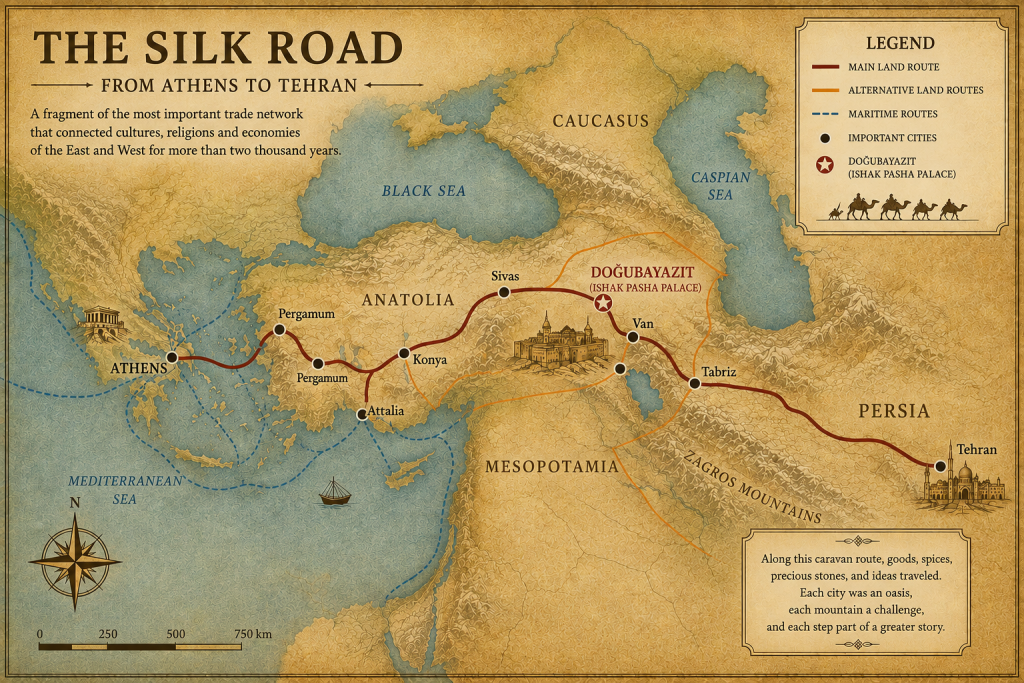
Situated on Karabulun Hill at an altitude of approximately 2,000 meters, overlooking the plain and the city, it served for more than two centuries as a symbol of the local rulers’ power, a guardian of the Ottoman Empire’s eastern frontier, and one of the most important stops on the ancient Silk Road.
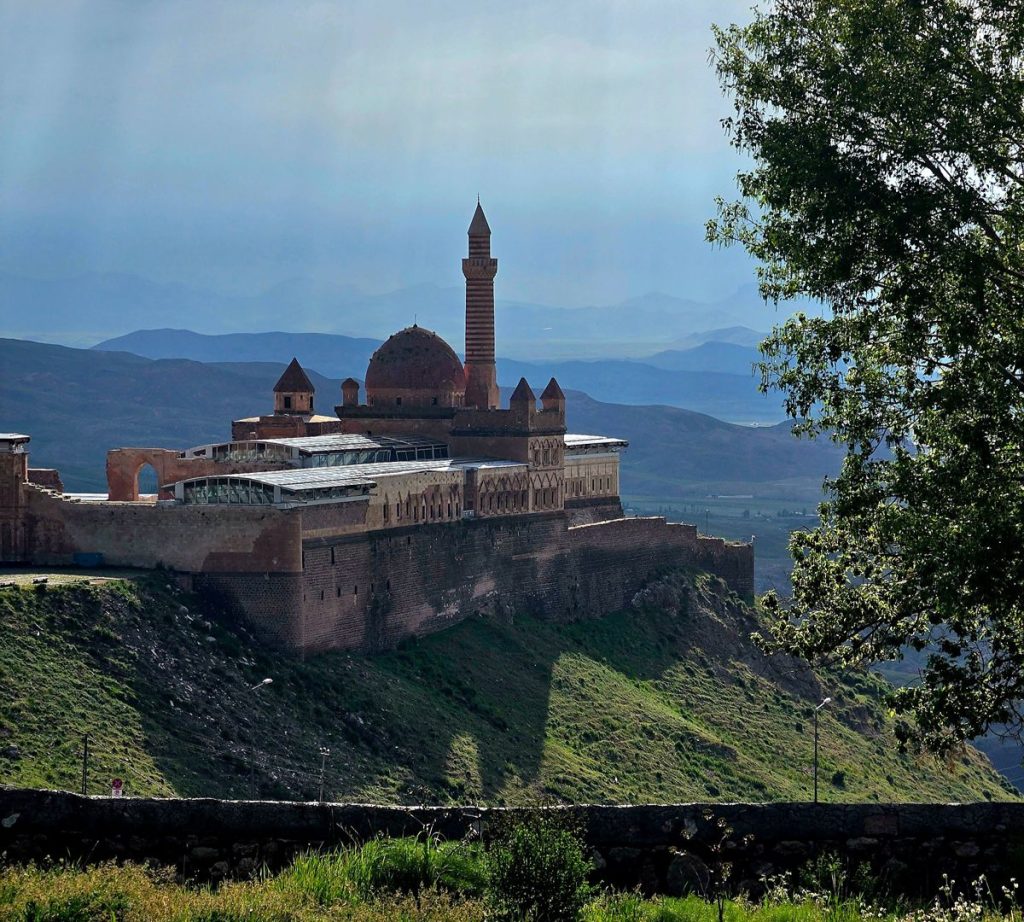
Ishak Pasha Palace, 2026
Nowadays, most people visit it during a trip to Mount Ararat. However, it is only upon arrival that one discovers it is no ordinary palace; it is a place where the histories of the Ottomans, Persia, the Kurds, and Europe converge.
A great deal of information about the palace’s turbulent history can be found online, but it is scattered. For years, I felt the lack of a single resource that brought together its history, architecture, and interesting facts into a coherent whole. While guiding groups through the Ishak Pasha Palace, I realized that—even when standing right there—there were still many details left to share. This article is an attempt to compile the knowledge I have gathered over the years spent living in the shadow of Mount Ararat.
Where the Silk Road Ended
The palace’s location was no accident; it was chosen with remarkable precision. For centuries, caravans traveling from Anatolia to Persia passed through the valley at its feet, serving as a source of customs duties, taxes, information, and political influence. From the palace terraces, one could observe virtually all the traffic along the Silk Road. Moreover, the terrain—specifically the steep hills upon which the palace stood—offered natural protection, making the stronghold difficult to capture even without extensive fortifications.
Peoples stronger than the empire
Its construction began in the 17th century; initiated by Çolak Abdi Pasha, it was completed nearly a century later by Ishak Pasha, from whom the palace takes its name. However, the most intriguing aspect of the palace’s history lies not in its construction by Ottoman governors, but in the practice of using semi-autonomous rulers and local clans—acting as the Sultan’s representatives—to administer the border regions. One such clan was the Çıldıroğlu family (also spelled Çıldıroğulları); in practice, it was they who collected taxes and ensured the security of the caravans.
The 17th and 18th centuries were a time of constant tension between the Ottoman Empire and Persia. The region of Bayazıt (present-day Doğubayazıt) was one of the most important gateways to the Caucasus and Iran. It was not a quiet corner of the empire, but rather its most remote outpost.
The sultan was fully aware that governing the region without the help of local clans would prove practically impossible. Consequently, authority was entrusted to influential Kurdish families, who were granted extensive autonomy in exchange for their loyalty.
Therefore, it can be stated that the palace was not a demonstration of the power of the Ottoman Empire itself. It was, above all, a demonstration of the power of the men who governed its most remote frontier.
Luxury at the End of the World
As for the structure itself, a sewage and running water system was installed, heating was provided in some rooms, and a fountain that flowed with milk was set up in the courtyard—features that were remarkably modern for the time. For many years, it was considered the second most important palace in the Ottoman Empire outside Istanbul (though it should be noted that this refers to its regional significance rather than its official status).
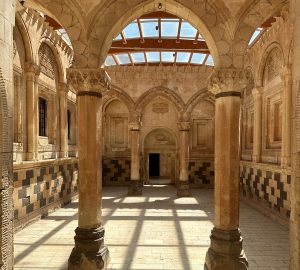
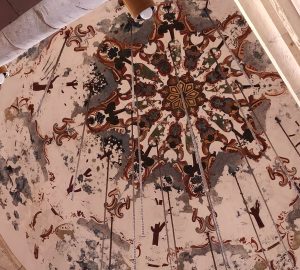
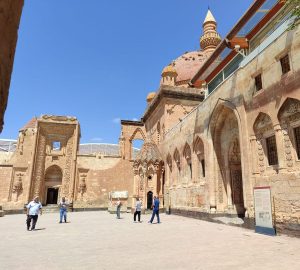
Today, the most spectacular parts of the palace are the courtyard, the reception hall, and the mosque, where original frescoes and decorations in Seljuk, Persian, and Caucasian styles—as well as Baroque and Rococo—can be admired.
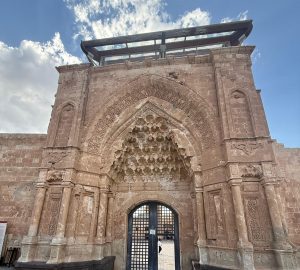
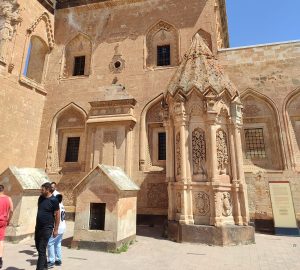
An exquisitely decorated portal—one of the palace’s most striking features—leads from the courtyard to the residential area. The architects employed a *taç kapı*, a monumental gateway characteristic of Anatolian madrasas and caravanserais. Deeply carved stone frames, geometric ornaments, and floral motifs create an effect reminiscent of stone lacework.
Few people notice the figures on the palace’s north façade. There, one can find a winged dragon, a lion, and human figures.
It is unclear whether they served a purely decorative function or also held symbolic significance. In Seljuk and Persian cultures, the dragon typically represented protection and strength, while the lion symbolized power and courage. This is a particularly interesting motif, as similar representations are virtually non-existent in classical Ottoman architecture.
A love that perhaps never was
I must also dispel a myth deeply held by visitors to this site: the palace does not offer a panoramic view of Mount Ararat. A local legend holds that Çolak Abdi Pasha built the palace to prevent his daughter from seeing the shepherd with whom she had fallen in love. Another version claims he ordered the architect to create a structure worthy of Ararat’s majesty. These are beautiful stories, yet there is no evidence to confirm their veracity. Nevertheless, they demonstrate just how deeply rooted the palace is in local tradition.
When the palace fell silent
Historically, the palace has been plagued by misfortune. After its construction was completed, it remained in use only until 1840, the year an earthquake caused considerable damage; its subsequent reconstruction took another twenty years. In the wake of the Russo-Turkish War (1877–1878), it served as an arms depot, a period during which its most valuable elements and movable ornaments were stolen. It was used as an arms depot again during World War I. When the conflict ended, it was looted, devastated, and abandoned.
Its reconstruction did not begin until the late 20th century. It was based primarily on measurement documentation carried out by Mahmut Akok between 1956 and 1960, as well as on engravings and sketches by travelers, archaeologists, and researchers.
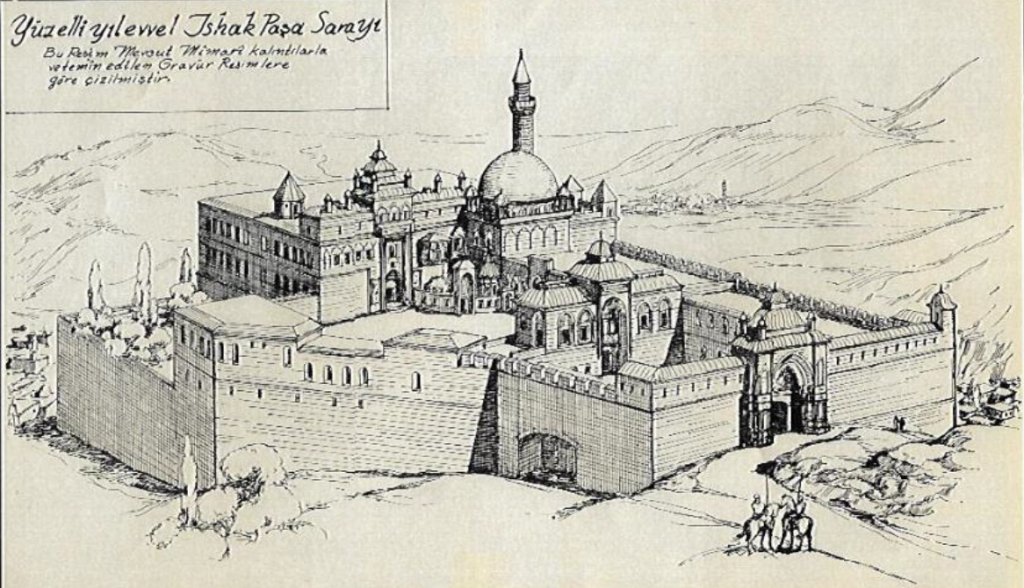
Mahmut Akok, Engraving of the palace (1956–1960)
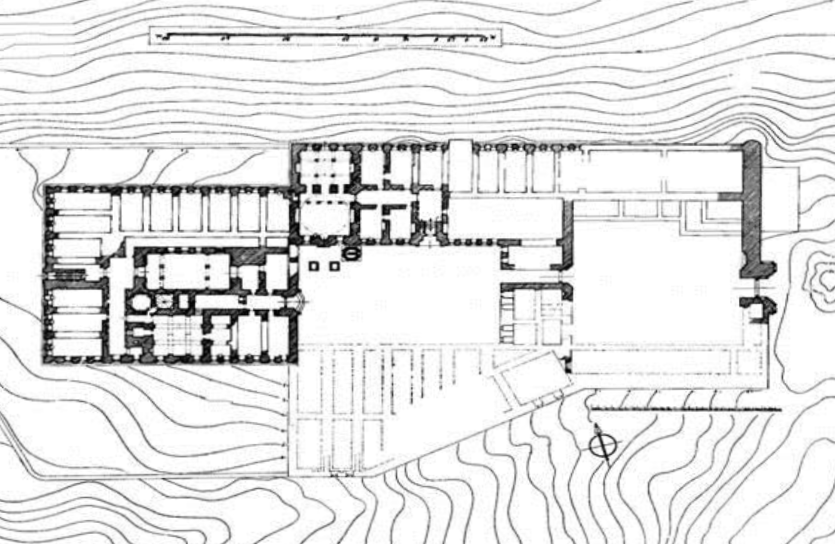
Mahmut Akok, Plan of the palace (1956–1960)
Drawing Report
The earliest known sketch is the work of Pierre-Amédée Jaubert and dates back to 1810. This French orientalist, translator, and diplomat had been sent by Napoleon Bonaparte to Persia on a secret diplomatic mission. While traveling through eastern Anatolia, he arrived in Bayazıt in the summer of 1805, where he was detained by the local ruler, Mahmud Pasha, on suspicion of espionage. Jaubert and his guide were imprisoned in the dungeons of the Ishak Paşa Palace, where they remained for nearly eight months until Mahmud Pasha died during a plague epidemic. Jaubert later recounted his experiences in the book *Voyage en Arménie et en Perse*, published in 1821.
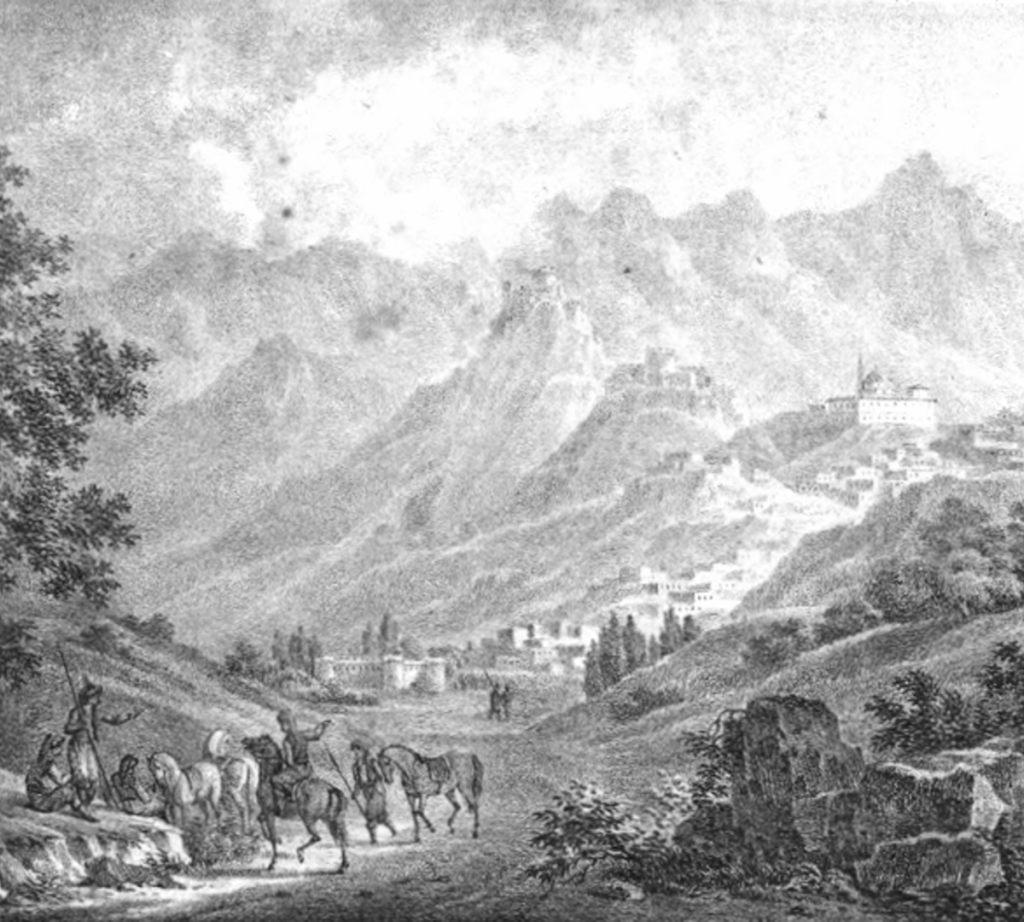
Engraving by Pierre-Amédée Jaubert, Ishak Pasha Palace, 1810
Decades later, Bayazıt was visited by the French architect, archaeologist, and antiquarian Charles Texier. He arrived around 1830, during an expedition aimed at documenting the monuments of Asia Minor and Mesopotamia. Unlike Jaubert, he was neither a diplomat nor a casual traveler; his goal was to gain a deep understanding of the region’s architecture.
Texier produced some of the earliest detailed depictions of the palace. His publication included three engravings showing the complex from the city side, the courtyards, and specific architectural elements. He particularly highlighted the remarkable combination of ceremonial and defensive functions, as well as the rich ornamentation of the courtyard and reception halls. To this day, art historians use his illustrations as a source to study the palace’s appearance prior to its subsequent destruction.
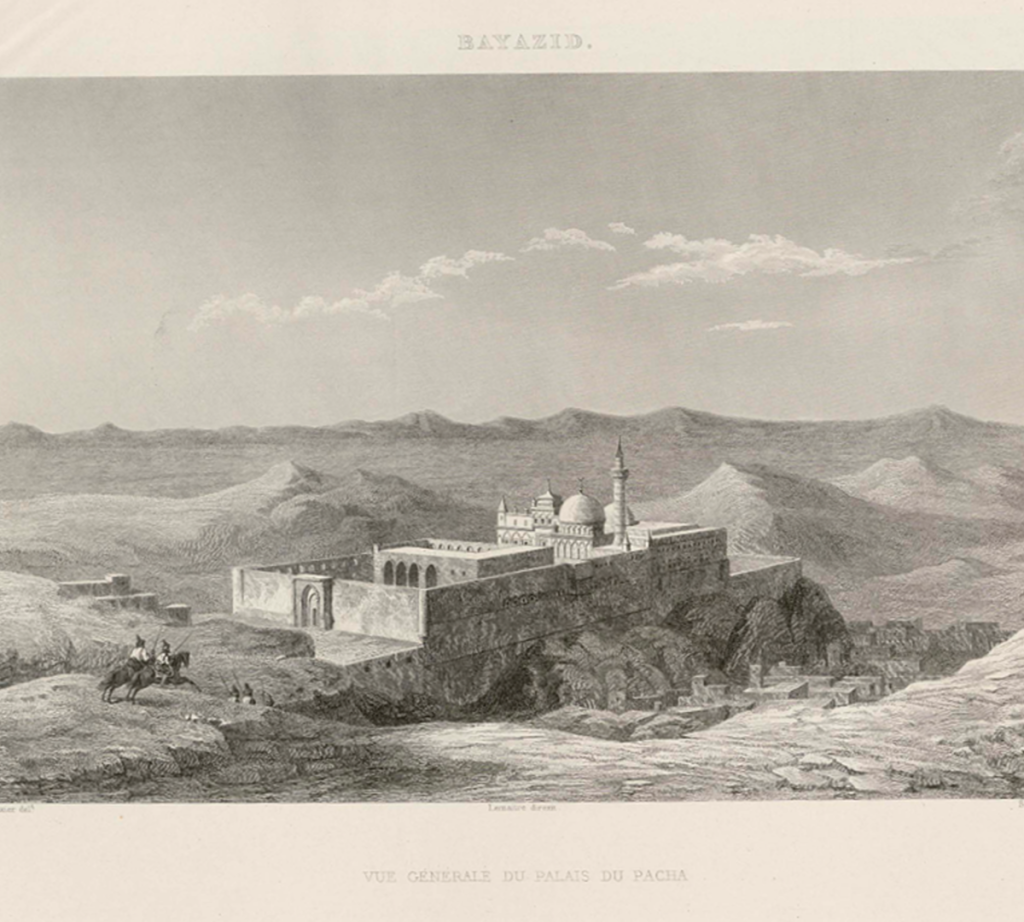
Charles Texier, Ishak Pasha Palace, 1842
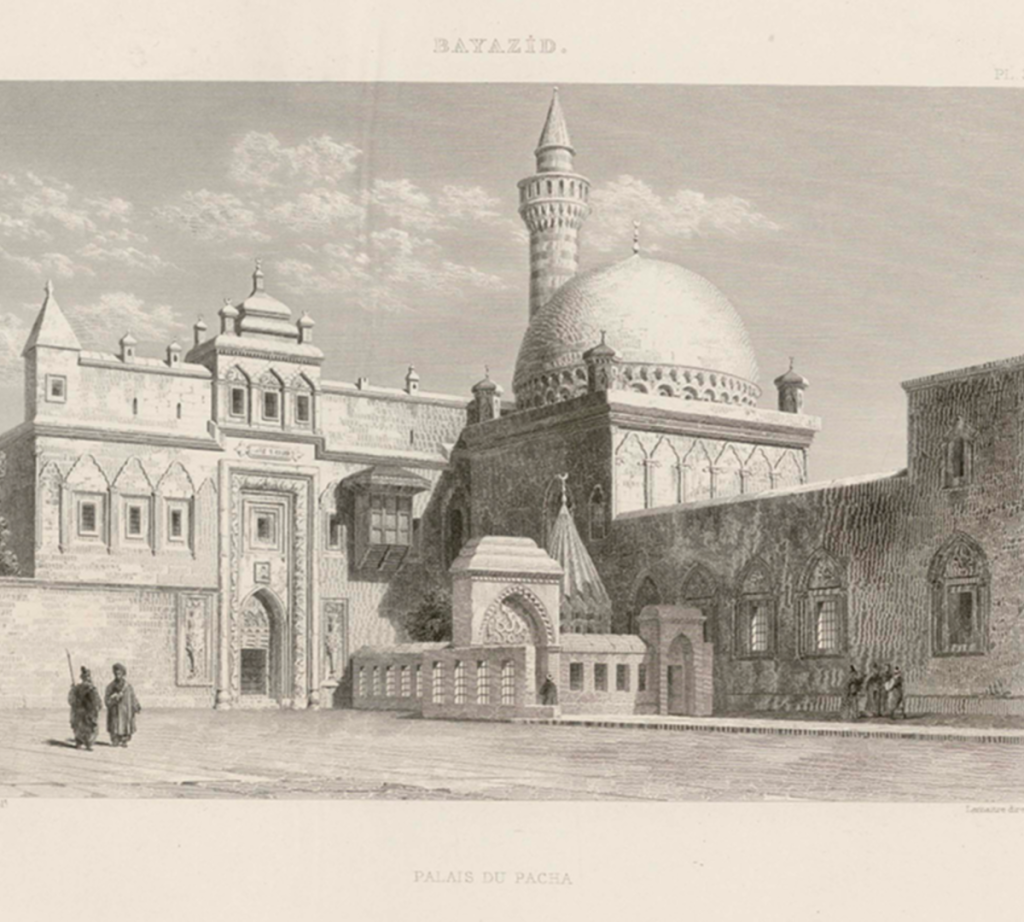
Charles Texier, engraving of the courtyard, 1842
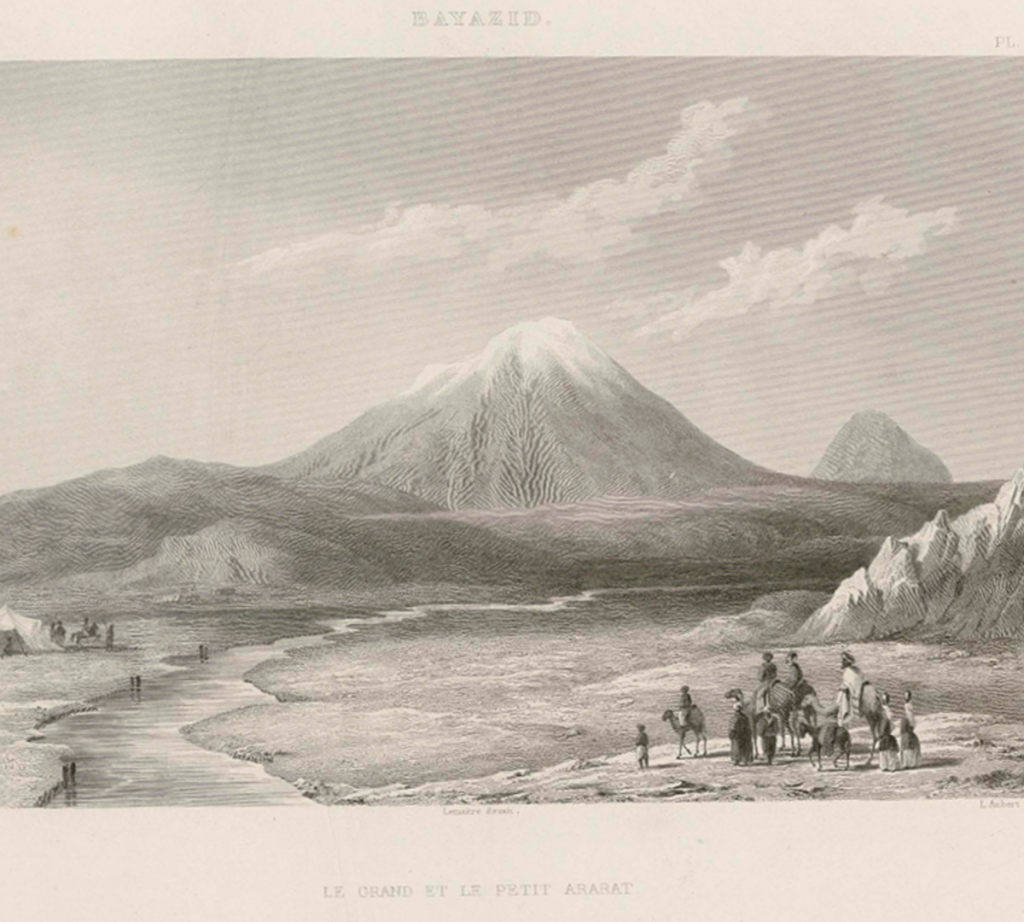
Charles Texier, Ararat, 1842
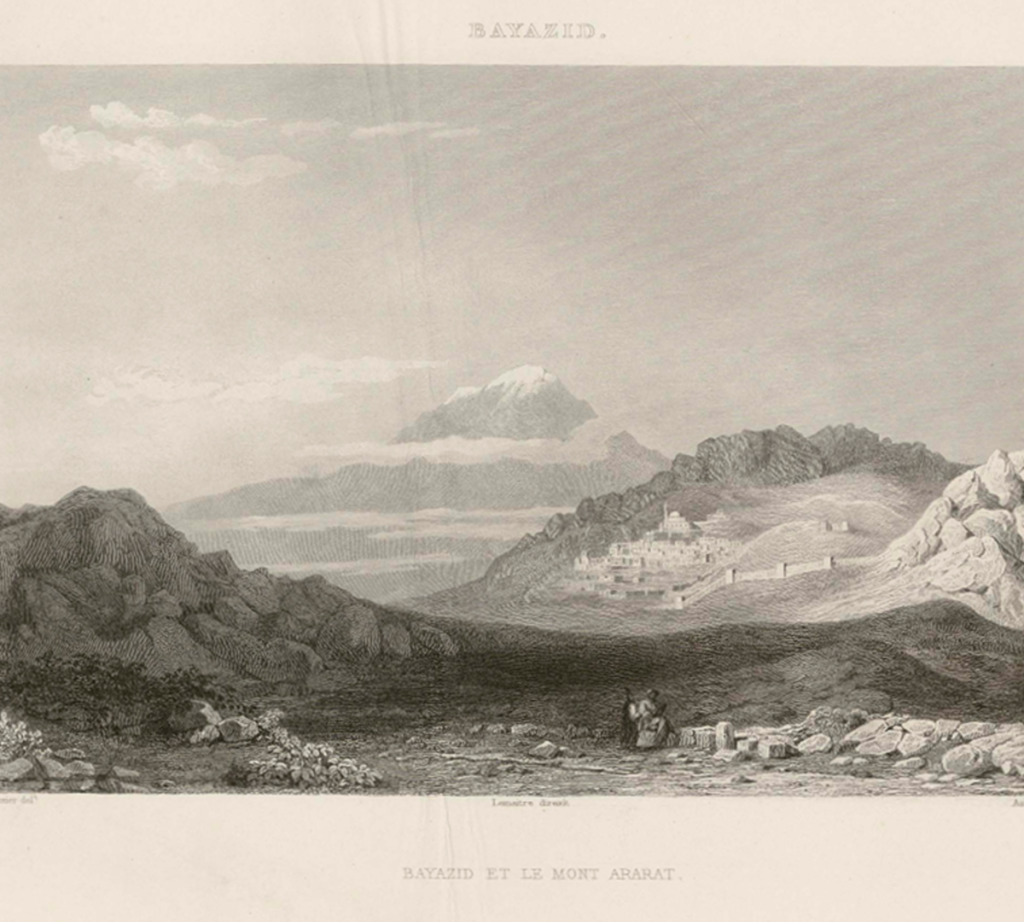
Charles Texier, The Palace and Ararat, 1842
Towards the end of the 19th century, the geographer and traveler Henry Finnis Blosse Lynch visited Bayazıt. The result of this expedition was the monumental two-volume work *Armenia: Travels and Studies*, which remains to this day one of the most important studies of the region.
Lynch saw the palace after the Russo-Ottoman War of 1877–1878, by which time it no longer served its former administrative function. In his descriptions, he highlighted not only the architecture itself but, above all, the structure’s extraordinary setting: perched high above the city, commanding a view of the Doğubayazıt plain and the Ararat massif. For Lynch, the palace was a symbol of the former power along the Ottoman-Persian frontier and one of the most distinctive landmarks in all of Eastern Anatolia.
When the mountain dust settles
The palace and the mountain almost always appeared together in descriptions, making it difficult to imagine one without the other even today. For many European travelers, this was also their first encounter with Mount Ararat. Today, the situation is very different: visitors focus on the mountain and leave the palace for last—often reluctantly or without fully realizing it. The moment of awe comes only upon crossing the palace threshold. This place reminds us that, for centuries, cultures, religions, and caravans traveling between Europe and Asia converged here. It is hard to imagine a better introduction to exploring Eastern Anatolia.
Kasia
Literature:
JAUBERT, P. Amédée, Voyage Armenie et en Persé, Paris, 1810
TEXİER, C. Description de l’Armenie, la Perse et la Mésopotamie, Paris, 1842
H. F. B. Lynch, Armenia: Travels and Studies, London, 1901
Yusuf ÇETİN „Eski Gravür ve Çizimlere Göre Doğubayazıt İshak Paşa Sarayı”
