
There are places in the world that are not merely points on a map. They are symbols—stories etched into human memory over thousands of years. One such place is the majestic Ararat, a solitary mountain associated for centuries with one of humanity’s most fascinating tales: Noah’s Ark.
An expedition to Mount Ararat is more than just a journey; it is a voyage into the depths of the history, faith, and cultures that have shaped this extraordinary region over millennia. As early as the Middle Ages, Armenian chroniclers described relics of the Ark sighted amidst the high glaciers. In the 19th century, European explorers began organizing the first scientific expeditions, while in the 20th century, aerial and satellite imagery reignited the world’s imagination. To this day, Ararat and the Ark remain among archaeology’s greatest mysteries. Yet, to truly understand this mountain, one must get to know the people who live in its shadow.
The region is inhabited primarily by Kurds, a people with an incredibly rich tradition and a strong sense of hospitality. It is the Kurds who act as guides, hosts, and guardians of local stories passed down from generation to generation.
The evenings at our camps on Ararat often become one of the expedition’s most memorable moments: over tea, one can hear stories of ancient caravans, legends about the Ark, and tales of life in that mountain setting—as rugged as it is beautiful.
Did the greatest flood in human history really end here? There is no definitive answer. Interestingly, various cultures and religions tell this story in slightly different ways.

The Road to the Noah’s Ark Museum

Noah’s Ark Museum
The Bible – “upon the mountains of Ararat”
The best-known account of the Flood is found in the Book of Genesis. It is there that we read:
“The ark rested on the seventeenth day of the seventh month on the mountains of Ararat.” (Genesis 8:4)
This is one of the passages most frequently cited in connection with Noah’s Ark. However, a specific detail is worth noting: the Bible does not speak of a single, specific peak, but rather refers to the “mountains of Ararat”—a mountainous region—and not to present-day Mount Ararat.
For many researchers, this is of great importance, as it opens up the possibility of various interpretations regarding the location.
The Quran – The Ark comes to rest on Mount Al-Judi
In Islam, the story of the Prophet Nūh also holds a very important place. In Surah Hud, we read:
“And it was said: ‘O earth! Swallow your waters! And you, O sky! Hold back!’ The waters receded, the matter was settled, and the ship came to rest upon Mount Al-Judi.” (Quran 11:44)
This is where the first significant difference arises. The Quran does not mention Ararat; instead, it names Mount Al-Judi (Judi), which many historians identify as Cudi Dağı in southeastern Turkey. Despite this difference, the story itself remains remarkably similar: a great flood, the construction of the ark, the salvation of the faithful, and a new beginning for humanity.

Noah’s Ark in the Quran

Marco Polo
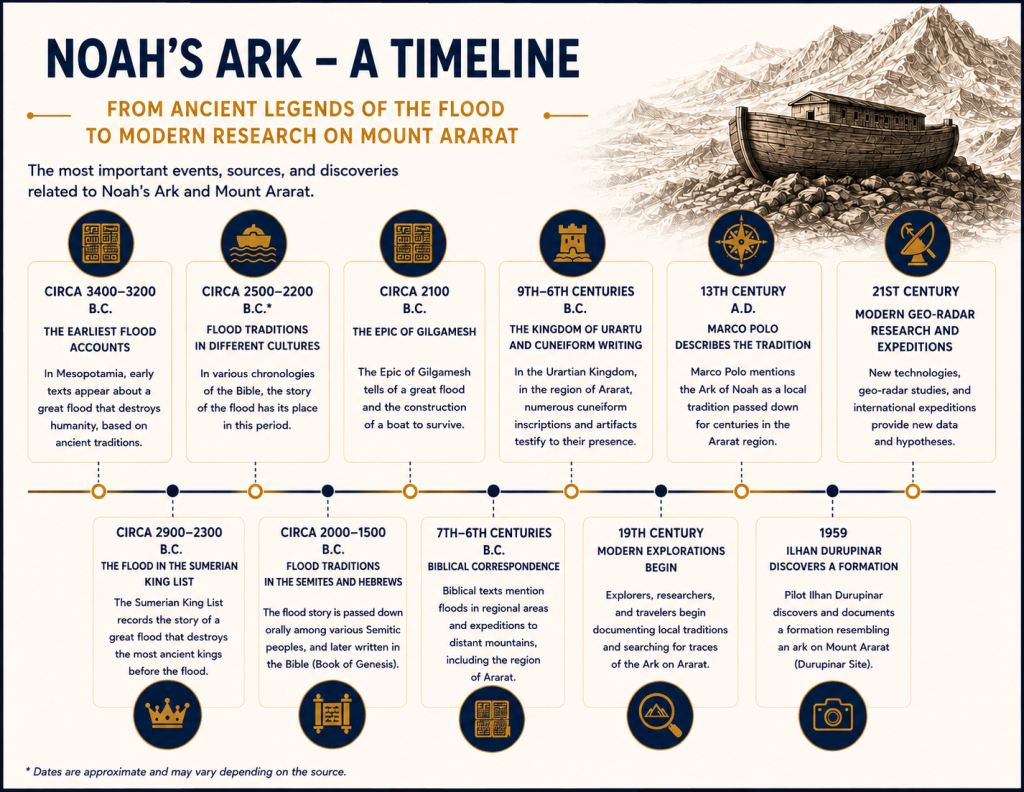
The Epic of Gilgamesh: the oldest story of the Flood
Long before the Bible was written, the inhabitants of Mesopotamia told a story remarkably similar to the account of Noah. However, the protagonist is not Noah, but Utnapishtim. He receives a warning of an impending catastrophe, builds a large vessel, takes his family and animals aboard, and survives a flood sent by the gods. Once the waters recede, he releases birds one by one to check if dry land has appeared.
This is one of the most striking elements of the entire story. The motif of releasing birds appears in both the *Epic of Gilgamesh* and the Bible, although the order of the birds differs.
Marco Polo: the legend arrives in Europe
When Marco Polo traveled through Armenia in the 13th century, he described a great mountain that the local population considered the resting place of Noah’s Ark. However, he did not claim to have seen the Ark personally; he simply recounted a local tradition that was already well known to the region’s inhabitants.
It was precisely because of such accounts that Western Europe began to increasingly associate the Ark with Ararat.

View of Mount Ararat from the Noah’s Ark Museum

View of Doğubayazıt from the first camp
So, given that so many sources mention the flood, did it all really happen?
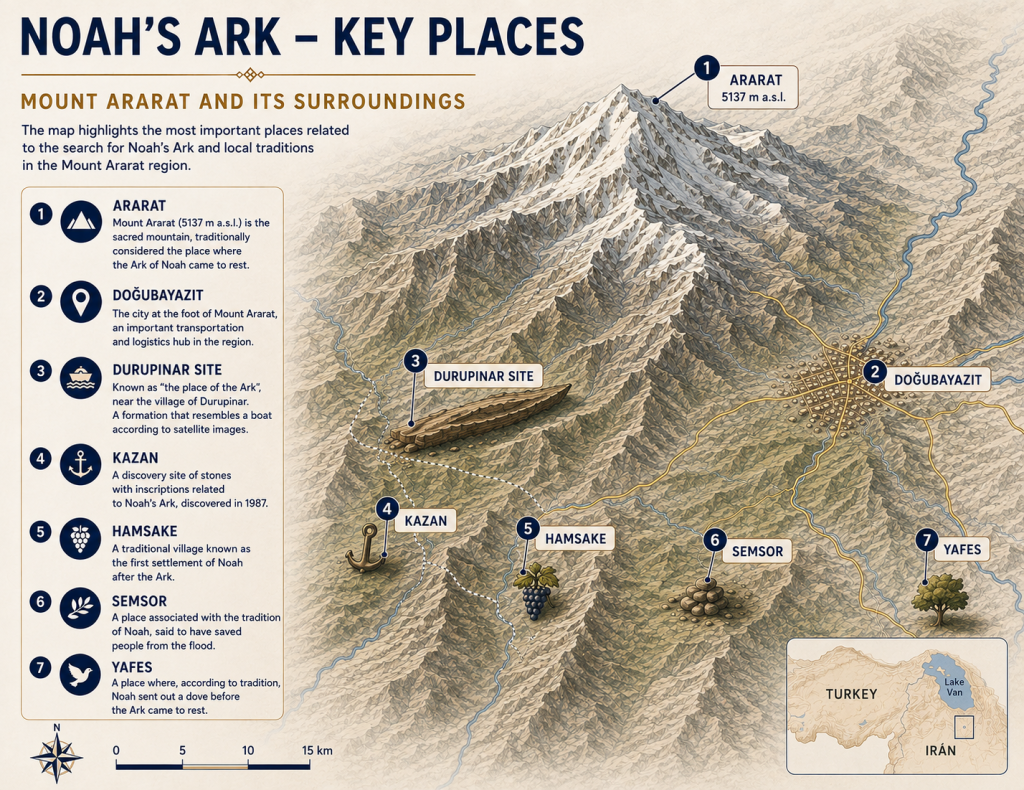
On August 11, 1959, Captain Ilhan Durupinar—who was involved in mapping eastern Turkey—discovered a formation resembling the resting place of the Ark while analyzing aerial photographs taken during a mapping mission. The location became known as the “Durupinar site,” and a museum dedicated to Noah’s Ark was established there, situated about 20 km from Doğubayazıt, right next to the Iranian border.
Subsequent measurements determined that the length of the formation was approximately 164 meters (older publications often cited a figure close to 157 meters or 515 feet). This figure approximates the length of the Ark described in the Bible, based on one interpretation of the length of the ancient cubit.
Los escaneos posteriores con georradar revelaron estructuras geológicas perpendiculares, lo que podría indicar que el sitio no es simplemente el resultado de terremotos y erosión, sino una construcción artificial. Se cree que estas estructuras reflejan la disposición de las cubiertas del Arca.

Captain Ilhan Durupinar

Ground-penetrating radar measurements
Rocks containing marine fossils are frequently found in the vicinity of the Durupinar site, as well as other stones bearing petroglyphs and inscriptions in cuneiform and Sumerian scripts. Local inhabitants continually discover new sites that bear witness to human presence and a deep faith in God.
It is the most famous site, having sparked the interest of researchers and pilgrims for decades. However, despite numerous studies, no evidence has been found that convinces the majority of the scientific community.
Furthermore, according to the tradition surrounding Mount Ararat and Noah’s Ark, Noah’s three sons established the first settlements in the vicinity of the mountain, and the names of some of these places preserve the memory of their founders. Thus, it is said that Ham founded Hamsake; Shem, Semsor; and Japheth, Yafes—all located in the Ararat region. While this element of local tradition—handed down by the area’s inhabitants—is etymologically consistent, it has not yet been historically corroborated.
Another notable site linked to the history of the Ark is the village of Kazan, home to massive stone stelae carved with crosses. Some researchers—notably Ron Wyatt and his followers—believed these were anchor stones for the Ark, intended to stabilize the enormous vessel during storms. Geologists, however, regard them as Bronze or Iron Age cult monuments unrelated to the Ark.

Fossils discovered at the Durupinar site

There are as many theories and speculations as there are people and researchers. Yet one thing is certain: standing on the slopes of Ararat at dawn, it is easy to understand why this particular mountain has captivated the imaginations of travelers, researchers, and pilgrims from around the world for centuries. Those who climb Ararat discover something different: silence, humility, and the sense of being part of a story far greater than ourselves. Perhaps that is precisely why travelers return transformed. If you dream of a journey that combines adventure, history, and deep emotional resonance, Ararat awaits you.
Your story can begin right here. After all, the Ark is a symbol of life’s journey and new beginnings.
Kasia
